By Bharat BagreePublished on
Rise
The Survivor of the Big-Box Electronics Wars
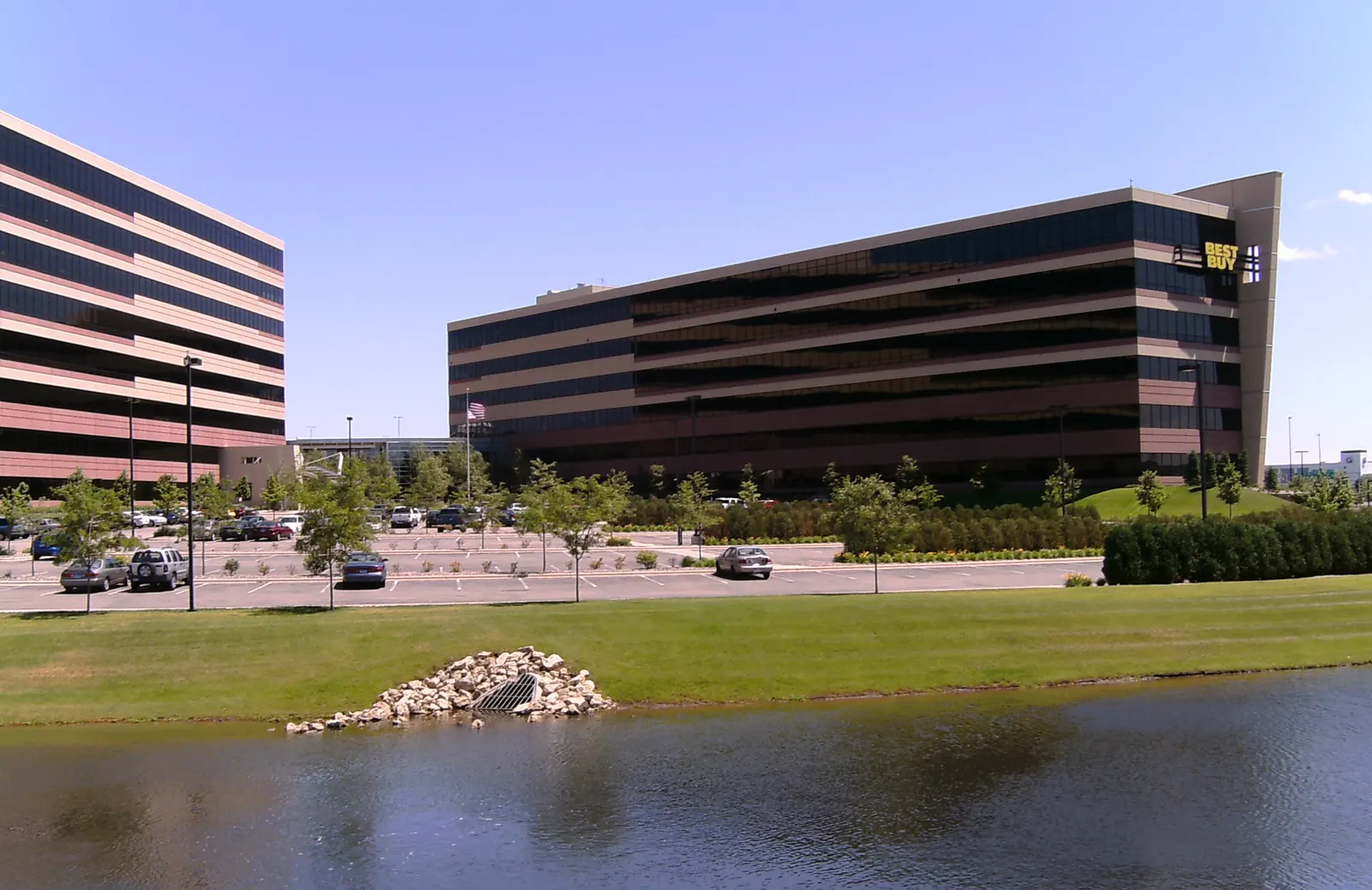
Best Buy traces its origins to 1966, when Richard Schulze founded an audio equipment store in St. Paul, Minnesota, later renamed Best Buy in 1983 as it expanded into a broader consumer electronics retail format. Through the 1990s and 2000s, Best Buy grew into the dominant big-box consumer electronics retailer in North America, a position reinforced significantly by the 2009 liquidation of its largest direct competitor, Circuit City.
For a period following Circuit City’s collapse, Best Buy appeared to have won the big-box electronics retail category decisively. That victory proved short-lived, however, as the threat to Best Buy’s business model shifted from brick-and-mortar competitors to an entirely different kind of competition: e-commerce.
Fall
“Showrooming”: When Your Own Stores Sell for a Competitor
“Showrooming” is the word that came to define Best Buy’s decline. Customers would visit a store to see, touch, and get advice on a television or laptop from a knowledgeable employee — then buy the identical item from Amazon that night, for less. Best Buy was paying rent, payroll, and inventory carrying costs to run a free demo counter for its own biggest competitor.
The math was brutal. A warehouse-and-shipping model simply carries less overhead than a nationwide footprint of big-box stores, so matching Amazon on price without changing anything else meant matching it at a loss.
Analysts started reaching for the same comparison, again and again: Circuit City. Best Buy’s chief rival had liquidated in 2009, and by 2012 the trade press was openly asking whether Best Buy was walking the same path, just a few years behind.
Crisis
A Governance Scandal Compounds a Business Crisis
Then the board blew up. An internal investigation found that founder and chairman Richard Schulze had failed to properly report CEO Brian Dunn’s inappropriate relationship with a subordinate employee. Schulze resigned as chairman; Dunn resigned as CEO separately amid the fallout. Best Buy now had no permanent CEO and a deteriorating core business at the same time.
Best Buy’s stock fell to roughly $11 per share by December 2012, a steep decline from levels in the $40s just a few years earlier, as investors weighed the compounding effects of showrooming, the leadership crisis, and broader skepticism about whether any big-box electronics retailer could survive Amazon’s growing dominance.
It was against this backdrop — a damaged board, a vacant CEO position, and a business model under direct existential threat from e-commerce — that Best Buy’s board recruited its next chief executive.
Turnaround
Guaranteeing You’d Never Lose on Price
Best Buy hired Hubert Joly, an executive with a background in travel and hospitality at Carlson Companies, as CEO in September 2012. He had never worked in consumer electronics retail. Two months later, on November 13, 2012, he stood on stage at the Best Buy Theater in New York’s Times Square and laid out “Renew Blue” to investors: five pillars, built to confront showrooming head-on instead of managing its decline.
The most direct pillar was a price-match guarantee. Best Buy would match Amazon and every other major online retailer at the register, killing the one reason to browse in a store and buy on a phone. It meant accepting thinner margins on a real slice of sales — a bet against the company’s own numbers in the short term.
Renew Blue also targeted roughly $1 billion in annual cost reductions, streamlining operations to make those thinner margins survivable. Employee training and morale got real investment too, on the theory that a knowledgeable salesperson is the one thing Amazon genuinely cannot ship to your door.
Strategy
Turning Vendors Into Partners, Not Just Suppliers
Beyond price matching, Best Buy’s strategy under Joly restructured its relationship with major electronics manufacturers, striking agreements with Samsung, Apple, Microsoft, and other vendors to build dedicated, branded “store-within-a-store” spaces inside Best Buy locations — with vendors, rather than Best Buy alone, covering a significant share of staffing, fixtures, and display costs.
It worked for everyone at once. Vendors got a controlled, premium showcase for their products at a moment when Apple and others were investing heavily in their own retail stores. Best Buy got someone else to help cover the cost of a good-looking, well-staffed showroom. Customers got something a browser tab still can’t replicate.
Best Buy also invested in ship-from-store logistics — turning its thousands of physical locations into a distribution network rather than treating them as pure overhead. The same real estate that had looked like a liability against Amazon became a way to get a package to a nearby customer faster than a centralized warehouse ever could.
Leadership
An Outsider’s Focus on Employee Morale
Joly’s lack of a consumer electronics background is usually described as an asset, not a gap in his resume. He had no fixed idea of what a big-box electronics retailer was supposed to look like, which made it easier to rewrite vendor contracts and pricing policy in ways a 20-year industry lifer might have talked himself out of.
He visited stores directly. He put real money behind frontline staff training. Most retail turnarounds treat headcount as a line item to shrink; Joly treated it as the whole point of having a store at all.
This leadership approach required navigating the immediate aftermath of the Schulze-Dunn governance scandal carefully, rebuilding trust with a board, employee base, and investor community that had been shaken by a leadership crisis layered directly on top of an already severe business challenge.
Innovation
Making Physical Retail Amazon Couldn’t Replicate
Best Buy’s central innovation was reframing the competitive question from “how do we compete with Amazon’s prices” to “what can a physical store offer that pure e-commerce cannot” — and then building the vendor showcase partnerships, staff training, and price-match guarantee needed to make that reframing commercially real rather than aspirational.
The “store-within-a-store” model aligned two sides that used to just transact with each other. Manufacturers wanted a premium physical showcase; Best Buy wanted someone else to help pay for it. Other retailers have since borrowed the same playbook wholesale.
Best Buy’s ship-from-store fulfillment innovation similarly converted what many analysts had treated purely as a cost disadvantage — a large network of physical stores — into a logistics advantage, allowing faster delivery to nearby customers than a purely centralized warehouse model could offer.
Financial Recovery
From a Circuit City Comparison to a Top-Performing Stock
The market did not wait long to change its mind. From roughly $11 a share in December 2012, Best Buy stock climbed to one of the best-performing positions in the entire S&P 500 during 2013 — more than doubling within the year. By the time Joly stepped down years later, the stock had run from around $18 to over $65.
Renew Blue hit its own cost-savings target, roughly $1 billion in annual reductions, while same-store sales stopped declining and started growing again. That combination — cheaper to run, and actually selling more — is what put the Circuit City comparisons to rest.
Best Buy became the rare big-box retailer that proved you could out-Amazon Amazon on the thing Amazon can’t do: put a real person in front of a customer. Other retailers have been citing the case ever since.
Lessons
What Best Buy’s Turnaround Still Teaches
Best Buy’s recovery demonstrates that a specific, well-defined competitive threat — showrooming — can often be addressed with a direct, if financially uncomfortable, countermeasure (price matching) rather than requiring an entirely new business model. The company did not abandon physical retail; it removed the specific reason customers were using its stores without buying from it.
The second lesson is about who pays for what. Best Buy stopped treating manufacturers as pure suppliers and made them partners in the cost of a good store, which cut its own exposure and improved what customers actually walked into.
The third: a liability is sometimes just an asset nobody has repriced yet. Best Buy’s store footprint looked like dead weight next to Amazon’s warehouses — until vendor showcases and ship-from-store logistics turned that same square footage into an advantage Amazon couldn’t easily copy.